How to Cite an Image of a Work of Art
The principles of art (or the principles of design) are essentially a set of criteria which are used to explicate how the visual elements are bundled in a work of fine art. These principles are peradventure the closest thing nosotros take to a set of objective criteria for analyzing and judging art.
Art is a notoriously gray surface area when it comes objectively defining what is great and what is non. An creative person of one era may be mocked during his lifetime, notwithstanding revered after his passing (such equally Vincent van Gogh). The principles of art help combat this gray area to some extent. They permit usa to communicate what makes a slap-up painting slap-up with an element of objectivity and consistency.
The post-obit is an explanation of what the principles of art are and how you tin can use them to benefit your own artworks.
Pattern
Blueprint is a very of import pattern concept which refers to the visual arrangement of elements with a repetitive form or intelligible sequence.
Pattern is not ever obvious. It could be a unproblematic underlying notan design which dances between light and dark in some kind of sequence. Or it could be the employ of similar colour patterns throughout your painting.
In the painting below, notice how the top arm of the field of study almost blends into the background, and how the legs blend into the material, and the material blends into the residuum of the foreground. This interlinking blueprint drags you through the painting and creates a very interesting design.
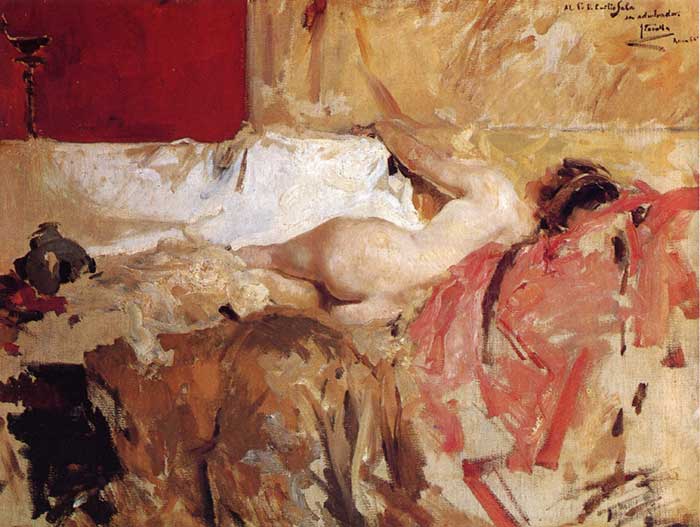
Joaquin Sorolla, Bacchante, 1886
Read more about pattern in art.
Residual
Balance is concerned with the visual distribution or weight of the elements in a work of art. A painting could be balanced if ane half is of the aforementioned visual weight every bit the other half. Or, you could have a small area of heightened significance which is balanced confronting a much larger area of less significance, like in the painting below. In the painting below, discover how the dark areas used for the boat and foreground appear counterbalanced against the much larger area of soft, tinted colors.
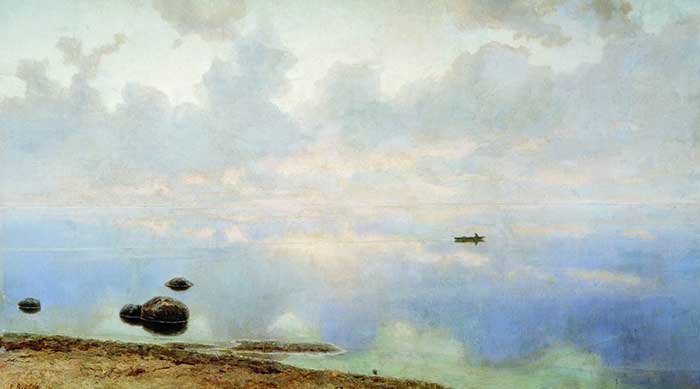
Efim Volkov, Seascape, 1895
Emphasis
Emphasis is a fashion of using elements to stress a certain expanse in an artwork. Emphasis is really just some other way to describe a focal betoken in your artwork. In the painting below, there is stiff emphasis on the moon through the use of colour contrast.
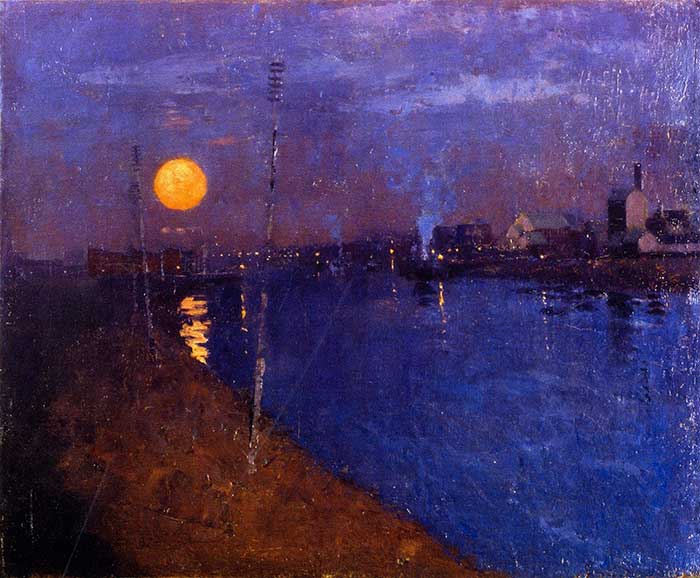
George Henry, River Landscape Past Moonlight, 1887
You lot can read more about emphasis in art here.
Contrast
Contrast is everything in art. Without it, an artwork would be nothing but a blank surface. Contrast can come in many forms:
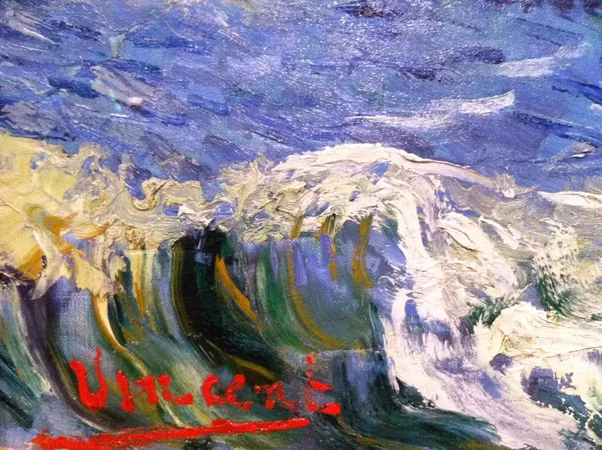
Texture contrast: A contrast between polish and textured. Many of Vincent van Gogh'south paintings are great examples of texture contrast in action.
Color dissimilarity: A dissimilarity between light and dark, saturated and boring or complementary colors (hue contrast). For case, in the painting beneath, the highly saturated red contrasts confronting the relatively dull colors in the rest of the painting.
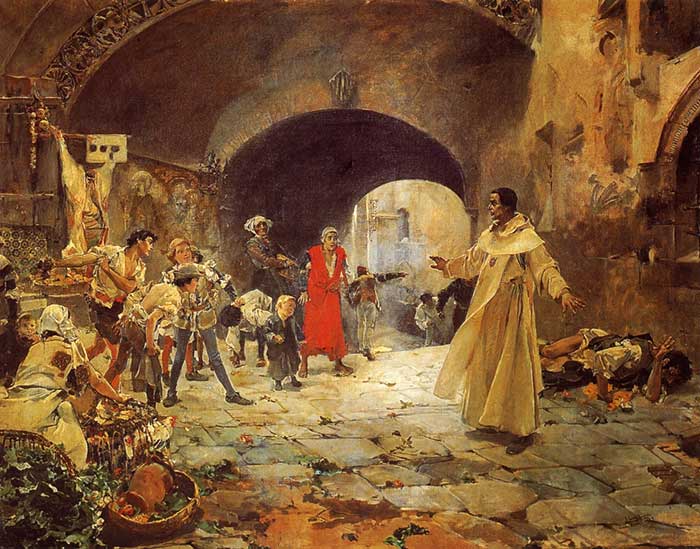
Joaquin Sorolla, Father Jofre Protecting A Madman, 1887
Particular dissimilarity: A contrast between areas of detail and more than bland areas, like in the painting beneath.
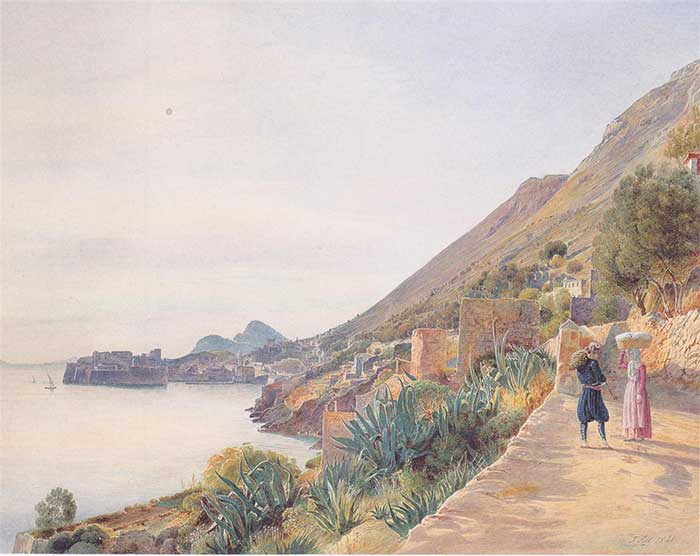
Rudolf von Alt, View Of Ragusa, 1841
Shape dissimilarity: A contrast between dissimilar shapes (rectangles and circles). For instance, in the painting there are the curving shapes created by the winding paths, water and copse contrast against the rectangular shapes of the buildings.
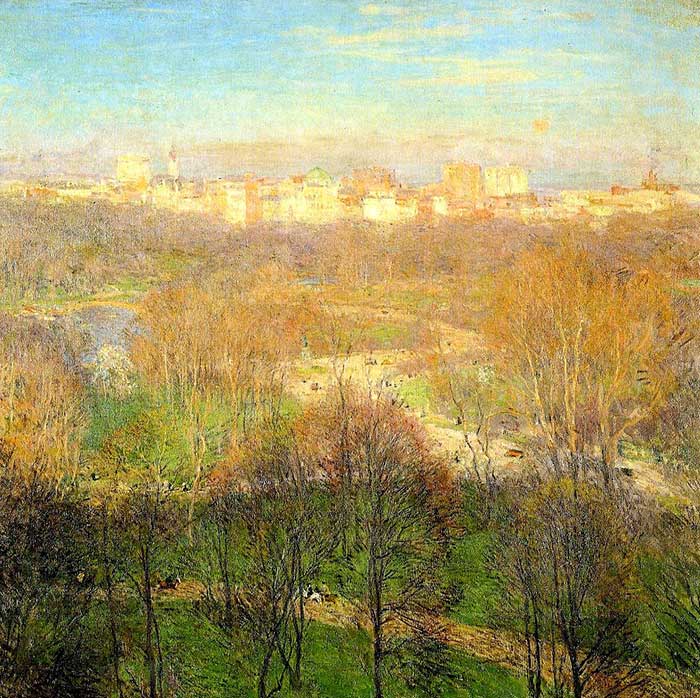
Willart Metcalf, Early Jump Afternoon, Primal Park, 1911
Interval contrast: A contrast between long and short intervals. In the painting below, observe the variation in the lengths of the intervals between the trees. The interval dissimilarity can be used to create a sense of rhythm in your artwork.
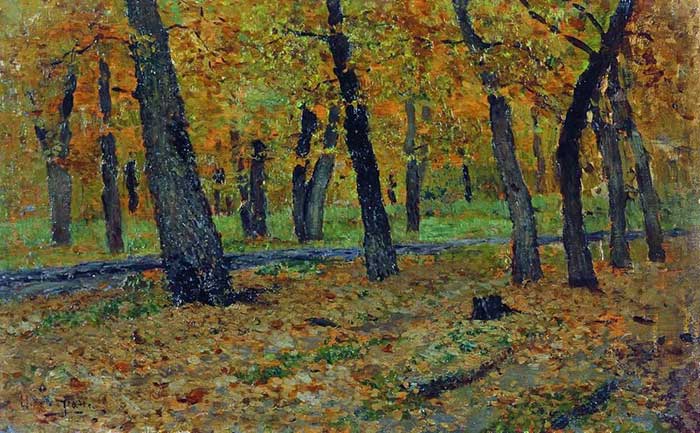
Isaac Levitan, Oak Grove, Autumn, 1880
Read more about using contrast.
Harmony And Unity
Harmony is a bit vague compared to some of the other principles. More often than not speaking, it refers to how well all the visual elements work together in a piece of work of fine art. Elements which are in harmony should take some kind of logical progression or human relationship. If there is an element which is not in harmony with the rest of an artwork, it should stick-out and be jarring to look at. Kind of like an off-note in a song.
You lot will normally be able to tell just from judgment if all the elements are in harmony. It volition but wait right. However, if the painting looks off, and then it tin exist difficult to tell if that is because at that place is no harmony between the elements or if at that place is another issue.
When I think of harmony, I think of the peaceful arrangements of colour in Monet's series of water lilies.
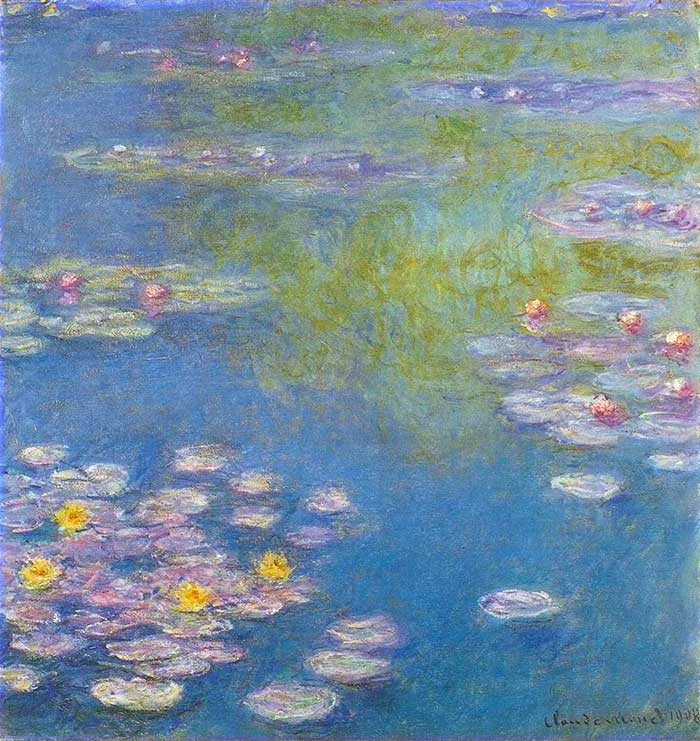
Claude Monet, Water Lilies, 1908
Unity refers to some kind of connection betwixt all the visual elements in a piece of work of art. Like harmony, this is a bit of a vague term which is difficult to objectively apply to clarify art. The painting below demonstrates a strong sense of unity through the apply of a similar hues used throughout the painting. Even though in that location is a stiff contrast betwixt the lite and dark areas, there is a sense of unity created through the use of similar hues (night yellows, oranges and greens are used in the foreground and light yellows, oranges and greens are used in the groundwork).
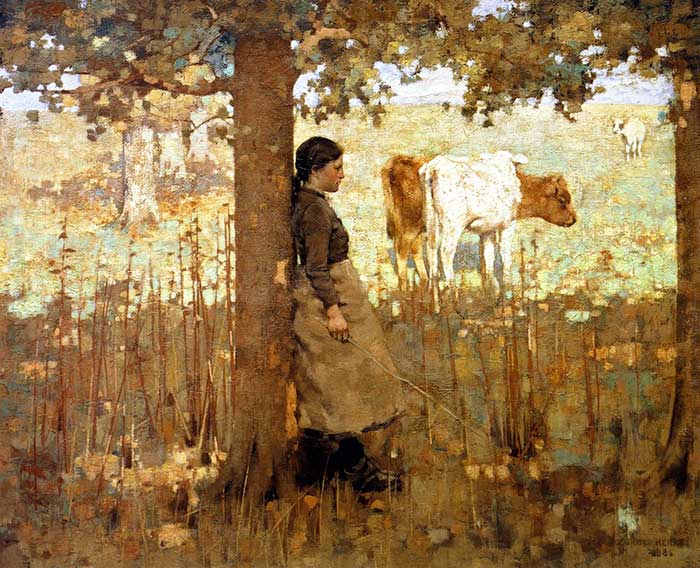
George Henry, Noon, 1885
Read more than near using harmony.
Multifariousness
Diverseness refers to the use of differing qualities or instances of the visual elements. Variety can be used to intermission up monotonous or repetitive areas.
Below is a painting with lots of variation in color, shape and texture, yet not and so much that information technology loses any sense of harmony.
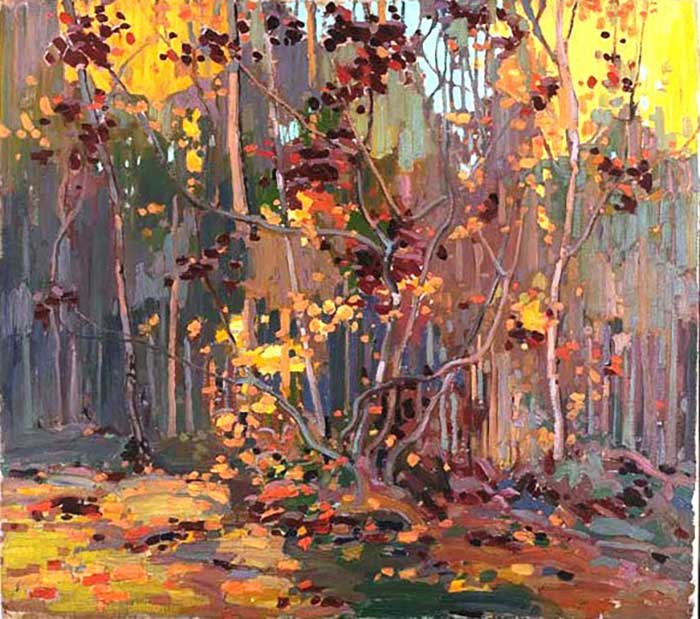
Tom Thomson, Maple Saplings, 1917
Below is a painting with comparatively less variance. The result is a much calmer painting.
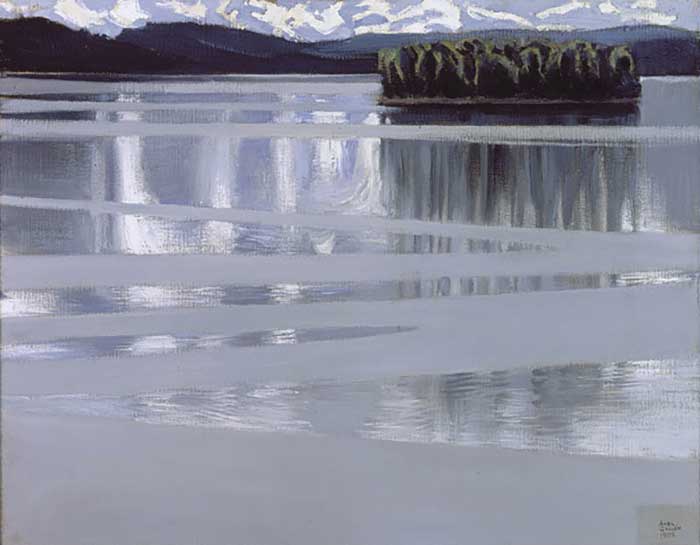
Lake Keitele, Akseli Gallen-Kallela, 1905
Movement
Your paints cannot physically motion, simply y'all tin can conform the paints in a way which gives the illusion or proffer of movement.
One of the about constructive techniques for creating movement in your painting is to use assuming and directional brushwork. By doing this, you can suggestively push your viewer around the painting equally you please. You could also suggest movement through repetition or design.
Beneath are two examples of paintings which demonstrate a great sense of motility.

Joaquín Sorolla, Sea And Rocks - Javea, 1900
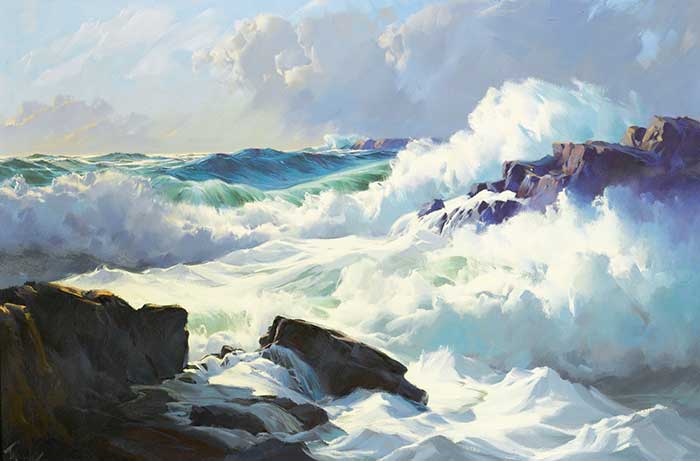
Frederick Judd Waugh, Breaking Surf
Too, I could not talk about using movement in art without some mention of Vincent van Gogh.
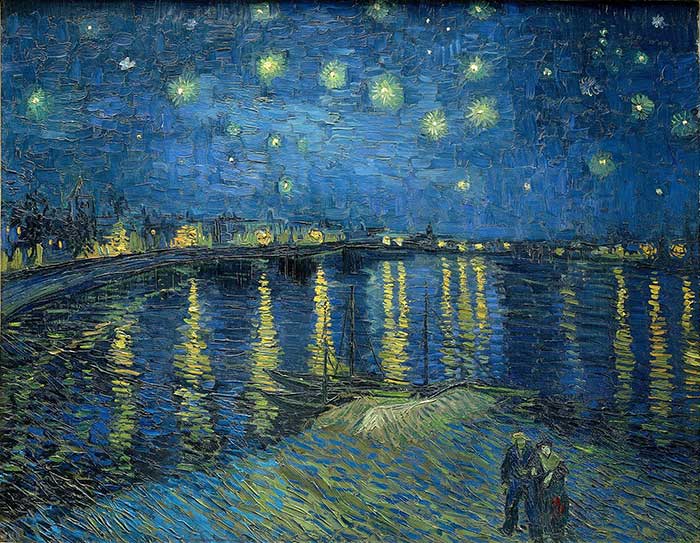
Vincent van Gogh, Starry Night Over The Rhone, 1888
Read more nearly move in art here.
Proportion
Proportion concerns the relationship between the sizes of different parts in an artwork. For instance, the width compared to the length, the area of the sky compared to the land or the area of foreground compared to the groundwork.
Some proportions are considered to be visually pleasing, such as the rule of thirds and the golden ratio.
In the painting below past Giovanni Boldini, notice how the proportions of the female subject'south hands, confront, anxiety and body are all authentic. If Boldini painted the hand too big compared to the rest of the field of study's body, at that place would be an issue of proportion.
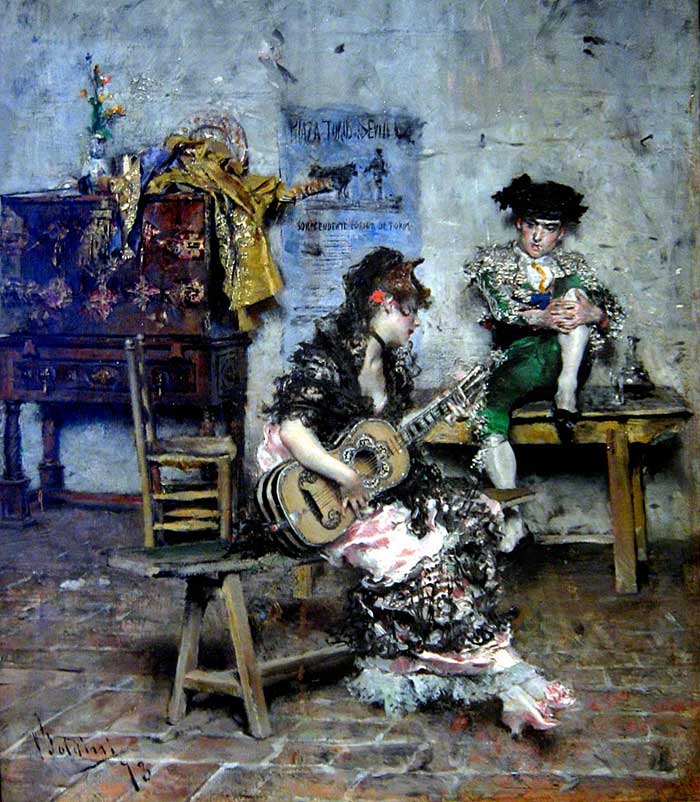
Giovanni Boldini, A Guitar Player, 1873
Scale
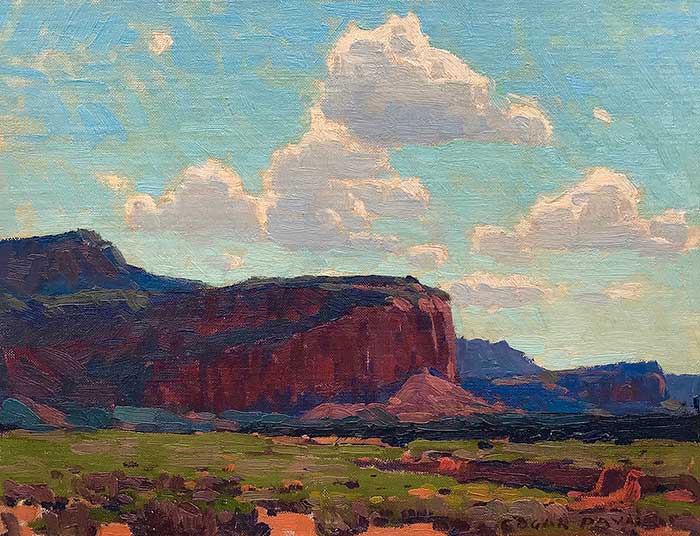
Calibration refers to the size of an object compared to the residual of the surroundings. For example, the size of a man compared to the tree he is sitting under or the size of a mountain compared to the clouds. Calibration is different to proportion in that scale refers to the size of an entire object whereas proportion refers to the relative size of parts of an object. For example, the scale of a man relative to the rest of the painting may be correct, but the proportion might be incorrect because his hands are too large.
Summary Of The Principles Of Art
I promise this post clarifies to y'all what the principles of fine art are and how you can utilize them to help understand and communicate your thoughts about art.
It is as well important to understand that a neat painting does not have to tick all the boxes in terms of the principles of fine art. Most of the great paintings will only demonstrate a few of the principles.
And then practice not think of the principles of fine art equally a set of overarching rules which you must comply with. They are merely a mode to assist us sympathise and communicate our thoughts about art.
The principles of art allow the states to place some kind of objective reasoning behind why a great painting is great. This is important equally it keeps united states of america from falling into a vague space where fine art is no longer able to be defined or critiqued (much like what has happened with modern art).
(If you desire to learn more about the principles of art, y'all might be interested in my Painting Academy course.)
clineforearephe51.blogspot.com
Source: https://drawpaintacademy.com/principles-of-art/
0 Response to "How to Cite an Image of a Work of Art"
Postar um comentário