Oneohtrix Point Never Live Nine Inch Nails Review
Classic interview: Oneohtrix Point Never - "For me a synthesizer is an abstract tool; I await at it and I'm merely guessing a lot of the time"
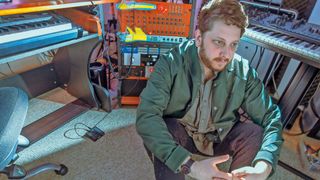
Currently in the spotlight thanks to his writing and production work on The Weeknd's critically-acclaimed album Dawn FM, nosotros spoke to Oneohtrix Betoken Never - AKA Daniel Lopatin - dorsum in 2015, as he was releasing his 2nd album for Warp Records, Garden Of Delete.
Since then, Lopatin's career has gone from force to strength. He'southward released two more than studio albums, composed highly-rated soundtracks (Good Fourth dimension, Uncut Gems) and produced not only for The Weeknd - both on Dawn FM and previous album After Hours - but also FKA Twigs.
Permit'due south go back to a time before all that, though, and find out how Lopatin got his start.
Not many people are lucky enough to have a dad who owns a Roland Juno-sixty. For Daniel Lopatin, it opened a portal into the earth of electronic synthesis, his labyrinth of electronic musings emerging under the moniker Oneohtrix Bespeak Never - a play on the frequency of his favourite Boston radio station, WMJX.
In 2010, Lopatin released Chuck Person'due south Eccojams Vol. 1, widely credited every bit a forerunner to the esoteric vaporwave genre. In the concurrently, the producer'south Oneohtrix Indicate Never project was signed to Indie label Editions Mego, spawning acclaimed albums Returnal and the following yr's Replica on his own Software label.
However, Warp Records was always a natural fit for Lopatin's morphogenetic experiments. The label released R Plus Seven (2013) and leveraged live back up for Nine Inch Nails, opening for grunge rockers Soundgarden.
Meanwhile, Lopatin'due south claustrophobic landscapes were accounted soundtrack-eligible for Sofia Coppola (The Bling Ring) and Ariel Kleiman (Partisan).
With new anthology Garden of Delete, Lopatin plunges the audience into another ambiguous, fictional universe. We caught upwards with him in his studio to detect out all most it and, indeed, him.
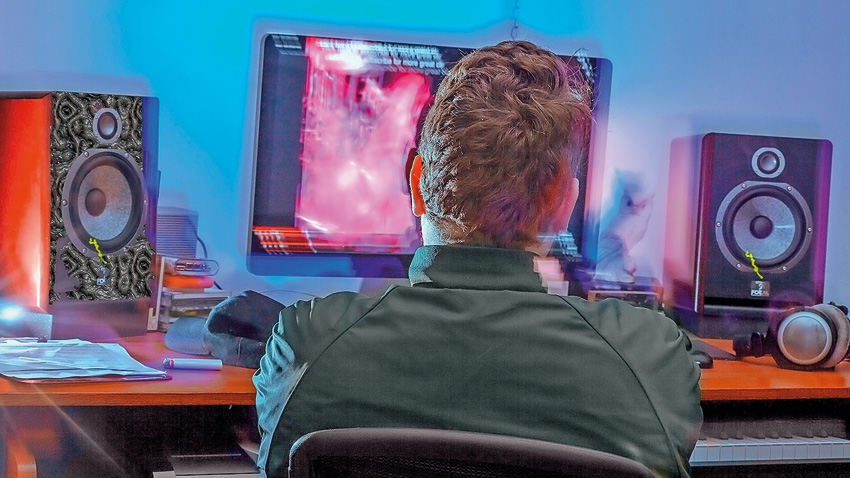
Untypically, it was your father'south love of jazz that lead you to electronic music…
"Yeah, because I grew up listening to my dad'southward fusion tapes and loved the keyboard work so much. When you're 10 or xi, information technology sounds like aliens talking to each other. And considering he was in some bands, he had a Roland Juno-sixty plugged into this Peavey 120-watt bass amp, and so he'd let me mess around with that."
Nosotros empathise the Juno-60 was also one of the beginning instruments you lot bought.
"That's true, because it's piece of cake and straightforward. It's an counterpart synth with some digital controls and a great arpeggiator, which was a large treat for me as a kid. I took the Juno with me to college and was using it in this high schoolhouse ring with my buddies.
"I was actually in a grunge band in middle school and got kicked out considering I auditioned 'to play bass', which I didn't have - I could only borrow it if I passed the audition. As soon as he saw me hold the bass, I was fired."
Did yous try to convince them to employ the Juno or merely take your own path?
"Well, years later when they were transitioning to be a jazz/funk quintet, they were like, 'Hey, we demand a keyboard player', and then I brought my dad's synth over. At that time, I was listening to Herbie Hancock's Sextant and Thrust, but also this evidence called Record Deck Tuesdays on college radio in Boston, and listening to a lot of hip-hop.
"Eventually I got a Goldie double CD with a crazy mix he made and my curiosity about linking instruments upwards together and sequencing them finally piqued. I got my hands on a very simple DCB sequencer for the Juno but realised information technology was totally shit, then I replaced it with MIDI so Cubase - then I started messing around with software. It's probably a pretty typical story for someone getting into electronic music."
Garden of Delete almost defies categorisation - is that intentional to continue the listener guessing?
"It'south funny, because in my head when I'grand making these things - and I realise that there's not a lot of objectivity when you're trying to brand a record and call up about what it is y'all're doing - I thought I was making my version of a rock tape. It's the well-nigh direct stuff that I could make, although I completely understand that information technology's maze-similar.
"The way I work is second nature to me, so I'one thousand non totally cognitive of how disruptive or insane information technology sounds. I similar that and think it adds something to the overall experience of the songs, but I do think of them as abstract rock tracks.
"I'1000 still figuring out my fashion of doing things incrementally. Going back to Returnal, every record gets a bit surer of itself in terms of songwriting. That'south why I was able to practise the MIDI thing, considering there were very articulate riffs and progressions."
Exercise you mean the MIDI files you uploaded to the Kaoss Edge website prior to the album's release?
"I was then bored with the typical cycle of premiering one song, and so the 2nd vocal, and and then there's a video or another gimmick and another gimmick after that. What if I gave these MIDI files out that just have the riffs for the main progressions from a bunch of songs on the album, so the first thing that people hear is a preview of the melodies, but they can skin it themselves and practice whatever they desire with it? I thought that was a more interesting and less played-out way of going almost sharing music."
And in issue, people can create remixes or different versions of your tracks?
"Yeah, because what I didn't really anticipate was that well-nigh people were taking the MIDI verbatim, which is absurd. I hadn't listened to the files before I dumped them on the cyberspace. They're really kind of unpolished, considering there were all these MIDI instrument chains on them and further processing once they were audio. And then a lot of the stuff yous're hearing in the raw MIDI is weird considering of the way the arpeggiator was timing. To hear the files without all these bells and whistles was baroque.
"Then, yes, to reply your question, I gave out an e-mail address and I'm trying to keep runway of all the mixes and create a repository, considering the people that are making them are normally my fans and I think it's a nice mode to acknowledge them."
"I remember nosotros were listening to Lithium and Ozzy's Boneyard and all this ridiculous rock stuff, and kind of getting into it and letting it seep in."
There'southward a surprising corporeality of guitar on the album and it's used quite aggressively. Why bring that element into a normally very electronic audio?
"I think that it was circumstantial. I went on this tour with Ix Inch Nails and Soundgarden. I was actually opening for Soundgarden, technically, and playing to their audition, which is not really mine; it's kind of similar a tap-out bro audience.
"So I was driving to these amphitheatres to make the 5:xxx soundcheck with my friend, and we had the satellite radio on just could simply discover music that was appropriate for this baroque situation nosotros found ourselves in. I call back we were listening to Lithium and Ozzy's Boneyard and all this ridiculous rock stuff, and kind of getting into it and letting it seep in. When I got off tour and got back to the studio it just felt similar a natural thing to exercise."
Did supporting 9 Inch Nails show you a different side of the manufacture to the insular activity of making music on your ain?
"100 per centum, considering it was a huge Live Nation tour. Unless I'yard at a festival gig, I'm usually playing to audiences of 300 people in Brussels or 800 in LA. And so going from that to an amphitheatre show, where I was playing to a Soundgarden audience who were really antagonistic, was very dissimilar.
"I talked to Trent [Reznor] and got his approving to do a pretty ambitious drone set, which was more similar to the music I was playing when I had five people in the audition, but I somehow felt that was going to become down amend for me."
How did it plough out?
"I only had about twenty minutes, so I fabricated 3 very epic pulsate-based pieces. I'd gone on a like tour in terms of calibration with Sigur Rós and done my normal set, but information technology didn't really popular off, and so with this ane, I was similar, 'How do I become them to remember'? I mean y'all take to entertain people, and you lot have to entertain yourself, so if they're non really going to sympathize the normal thing I do and so allow's at to the lowest degree leave this intense memory of a racket set."
There are few beats underpinning your music, almost as if the rug has been pulled from under you…
"This i actually has more than syncopation than any of the others, but that'due south probably telling of how lilliputian drums in that location are on most of my records. I don't like straightforward drum sounds and detest snares; tin't stand them.
"While I admittedly beloved a great drummer and become tunnel vision listening to drums at a show, a lot of the time I feel similar pulsate motorcar-driven music tethers you to a genre. Drums really drive the style of electronic music, so you stop upwards being like, 'Oh no, I'k in drum 'north' bass world or grime world', and I've never been comfortable enough to make a selection or commitment.
"I detect that when in that location's no drums and you have to find other ways to make syncopation, it adds this alienation to the place where I want to exist - a musical globe that I feel similar I could really belong to."
Is the album an interplanetary tale or is that my perception?
"I like that, let's coil with it. I think the concept for this record was actually memories of my puberty, because I don't take very clear ones so I started making a lot of shit up.
"The other aspect of that is that you tend to think the almost traumatic things. The nigh exciting moments are the most traumatising moments - or information technology seems like they're the only ones that survive. So when I was looking dorsum, all that was left was the trauma, so information technology felt like making a really dark tape was advisable."
Is your music an interpretation of the visual ideas pond around in your caput?
"Yeah, a lot of the time I'thou taking these inputs and asking myself how I can characterise that in musical class. And they don't necessarily have to be objects or places or landscapes; they tin can just be ideas, like ideas about stone.
"With some of them, it's like I'grand trying to be as close to a sculptor as I tin be, every bit opposed to being a musician. I'm trying to create these abstract forms that might exist suggestive of the influences and inputs I'm getting."
But not deliberating that?
"Yeah, it's vague. I'm not and then super-analytical about it, but I definitely like to think about the choices I make and try to call up of these things every bit weird little sculptures.
"The last record was probably more than explicit in that mode. I idea of that as a really domestic record, because I made it at dwelling and it was similar a bachelor pad before my girlfriend moved in, just she fabricated information technology actually peaceful and beautiful. I was spending a lot of fourth dimension with her, so to me information technology'due south a record of interiors, similar a bouquet of flowers or a tableau of some sort.
"Any more of that, though, and I would have repeated myself, so this album was totally done in a dungeon studio - a basement B editing room that I had at the very lesser corner of this building. I'd take the bus there and spend 12-15 hours in information technology. There were no windows, so you'd lose track of fourth dimension, and all of these bratty, adolescent impulses come up out in a infinite like that."
Listening to your music is like being attacked from all directions. Would environment sound exist a proficient fit?
"Yes. What we did for [2013 anthology] R Plus 7 was an issue where we did a multichannel version of the record in a round dome space.
"A surround version would be awesome for this record. I listened to Talking Head's Remain in Lite recently… a v-aqueduct surround version that they'd recently washed in a studio in LA that could really replicate it actually well, and I was like, 'Damn, this does so much for drums'. I love hearing percussion backside me, it only feels like you're at a testify or any, and I'd love to do that, so if everyone wants to be a patron of such an event…"
Is your setup software-based or a mix of gear?
"There's some hardware, but from an instruments point of view, almost of it was software on this record. But yep, I have a couple of preamps only to get the outboard synths sounding better going in. I've got a corking reverb pre and a UAD with a nice blend that helps me calibrate the audio if I want things to be a scrap more even and aggressive, or more tubed-out and variable."
What hardware synths are yous using at the moment?
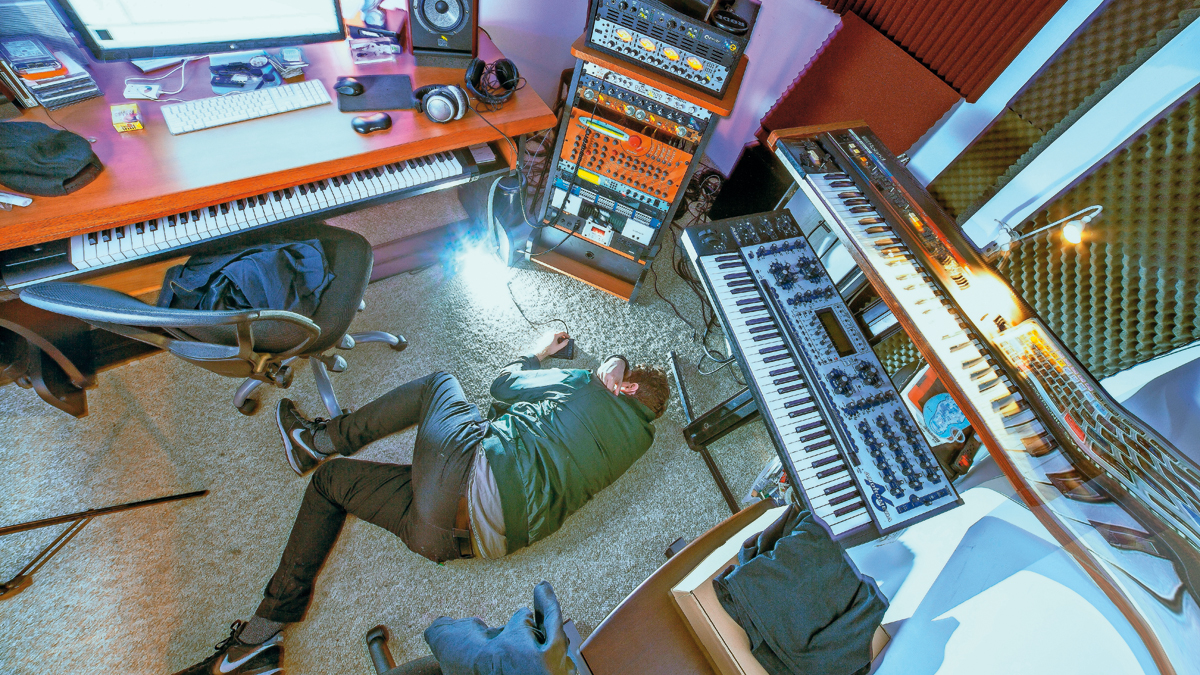
"I have the Juno-60 that I mentioned, an Alesis Andromeda, which is very pop these days. Everybody's putting out analogue synths again and the Andromeda is a late '90s synth only all analogue. Information technology'southward probably somewhat anachronistic today because there'southward so much effectually similar it at present, just I love how it sounds.
"I have a Waldorf Microwave XTC that I worship and control with a software editor chosen Monstrum XT that allows me to randomise its parameters, as I'thou not very expert at programming synths. I've also got an Elektron Analog Four, merely the rest of the stuff'south been decommissioned. If I'm not using something, I tend to sell it and motility on, and so I'm not too sentimental nearly hardware synths."
"If I'1000 non using something, I tend to sell it and move on, so I'm not besides sentimental well-nigh hardware synths."
In terms of sound creation, does using hardware appeal to you every bit much as software?
"I exercise think there is something to be said for rolling tape, working through some ideas and recording a crazy knob-twiddling session. Especially if you chop that stuff upwards; it usually turns out pretty keen.
"I find that when I sit downward at Ableton and start automating a lot of those things, I'thou budgeted it with a lilliputian bit also much purpose and premeditation, and tend to draw these direct lines; it just lends itself to being a little bit more analytical about how you want things to alter over time.
"Some people know what they're doing, merely for me a synthesiser is an abstract tool; I expect at information technology and I'm just guessing a lot of the fourth dimension, and so that helps me to get my fingers on information technology. The ideas are clumsier, although they are the better ideas sometimes."
Y'all moved to Ableton Live from Cubase, correct?
"Cubase was a pretty curt-lived love affair. I had a good handle on Pro Tools before Ableton, just it seemed to me to be no longer necessary.
"If I'yard producing somebody's record and there's a demand for more architecture or a band to come in and do that kind of recording, I would never use Ableton.
"The other thing that I dislike about it is the style information technology sums everything down to stereo if I just want to make a direct bounciness. I don't generally similar how that sounds.
"So there's a stop with Ableton as I actually don't want it to be the final location for a bounce. Everything upwardly until that moment, I'm sold - love it; but I try to become it broken out and audio a dissimilar way at another studio, usually with Pro Tools."
What plugin instruments and furnishings do you detect yourself turning to most oftentimes?
"I love [u-he] Zebra and used information technology extensively on this record. I love this company, Plogue, who fabricated a speech synthesizer called Chipspeech that I used for all the vocals. I love Ableton's vocoder and Operator for basic side subs and full general low-end.
"In that location's this really quirky, fucked up one I similar to use that's made by a company called Humanoid Sound Systems, chosen Enzyme, which is super-ambitious and industrial-as-fuck; it can't help merely sound like NIN Broken-era stuff. It'south the only thing information technology can do and information technology'south got a big fat random button on information technology, which is great for me.
"I like a lot of iZotope stuff for processing. Their EQs are great, simply their spectral sampling synth, Iris, is actually practiced as well, and so props to them for that. I use Spectrasonics Trilian a lot for the Chapman Stick-fashion stuff, and on the previous record I used Omnisphere a lot for choir sounds, just that's not news - everybody knows that."
We go the impression you honey that side of product, searching out plugins that can exercise weird and wonderful things?
"I'yard obsessed; I, like, troll Richard Devine's Instagram. Okay, I guess I lurk it, I don't troll - I respect the guy a lot. I would recommend to anybody that wants to go along upwards with stuff, you accept to follow Richard Devine'south Twitter and look at his Instagram, because he's pretty much constantly beta-testing everything and anything; he'south a good filter for that stuff.
"I wait for something that'southward really easy to use, something that allows me to quickly alter or destroy what I'm working on and flip or toggle the audio really quick without relying on presets. Randomisation is always something I become excited almost when I'm looking for a new VST."
One of the maxims on your studio wall was 'Do More than With Less'. Is that still how you look at things?
"Yeah, because I tended to be hoarding a lot of software, like Reaktor instruments and stuff, merely the more I recall about information technology, if you hear something yous like, simply work with it, don't overthink stuff or look for the perfect software, considering you're wasting your time. Your encephalon is going to be the most important software that y'all have… or I guess hardware - unclear at the moment [laughs].
"Don't worry too much about the gear and remember that your encephalon is going to be the matter that allows you lot to do the most with those tools. And likewise, if you lot like something about a audio but not everything, work destructively and think well-nigh twisting things up when they're audio. Don't always recall synthesis is the be all and terminate all for sculpting stuff. I retrieve audio is where information technology'due south at for me, because once it's audio I can really kickoff twisting it into its terminal grade."
How practice you translate your music to a alive setting?
"A lot of information technology is going to exist about dubbing out and remixing the record, and so there's a sure amount of playback involved in that.
"I usually make two versions of every album; one is the record I brand and the other is the one for the alive setting, and that involves a lot of reduction and making a knucklehead version of everything, taking out all the details and thinking, 'What'south the indicate here? Well, it's this riff'.
"OK, and then information technology's a syncopated series of samples; take everything else out and have it down to its bones component parts and that volition give yous plenty of infinite to add things live that are in the moment."
What gear will you typically apply to create the conditions for an improvisational set?
"Information technology will usually be Ableton with a couple of controllers and various pieces of software, where I take the main parameters fix up and so in that location'southward a logical menstruum on those two controllers. And so I'll use a 16-rail mixer where all of that stuff gets broken out.
"I tend to do more specific types of manipulation on the MIDI controllers, rather than dubbed-out Lee Scratch Perry-blazon tomfoolery on the mixer, with some Eventide stuff dealing with the big cloud-level ecology furnishings. The computational stuff is happening more on a micro level… little sounds in the box."
How interested are yous in bringing the music to life in a visual format?
"I work with this guy, Nate Boyce, who's a sculptor. He besides does the well-nigh insane video art ever. He'south incredible, then I allow him decide that stuff. He'southward also a musician and we're best friends, then he knows my stuff inside out and I usually give him carte blanche to express himself.
"What we're going to try and do for this upcoming bout is accept 2 giant flat-screen TVs vertically aligned with a lot of stuff that wouldn't make sense in landscape view - so more text, language and symbol-type stuff. And then a projection behind usa that's landscape-oriented and puts you lot in an environment… and hopefully a shit ton of dry water ice - that should do the play a joke on [laughs]."


All-admission artist interviews, in-depth gear reviews, essential production tutorials and much more.
Get the latest consequence at present!
clineforearephe51.blogspot.com
Source: https://www.musicradar.com/news/oneohtrix-point-never-drums-synths
0 Response to "Oneohtrix Point Never Live Nine Inch Nails Review"
Postar um comentário